Evidence-first
Evidence-first reporting that makes identity risk easier to explain and prioritise.
Evidence-first identity security
IdentityFirst MRI is the current GA offer: a read-only identity assessment with evidence-backed findings, launch-core connectors, and a clear first action without changing production systems.
IdentityFirst Core is the controlled rollout path once the first assessment proves value. IdentityFirst Enhanced and IdentityFirst AISF stay private beta until the support boundary is wider and the operating evidence is stronger.
Route guide: use assessment booking when you are ready to request a specific assessment or review. Use contact for a lower-commitment discussion first.
Choose the angle that matches your role. The page will keep the same story, but bring forward the problems and outcomes most relevant to you.
The story stays the same. The emphasis changes to match what matters most in your role.
Start with the big picture first
Focus on exposure, resilience, and board confidence
Focus on review effort, stale access, and control
Focus on governance, prioritisation, and value
Focus on evidence, assurance, and audit readiness
Focus on service creation, proof, and recurring revenue
Mark, IdentityFirst founder, walks through a dormant admin alert, the signed evidence it produces, and what each tier does — in one minute, read-only, nothing changed in your environment.
No account required. Privacy-first embed: no third-party cookies set on load.
Positioning
Evidence-first identity security that starts read-only and keeps humans in control.
Evidence-first
Evidence-first reporting that makes identity risk easier to explain and prioritise.
Read-only day one
Read-only on day one so teams can start without changing production systems.
Human-approved writes
Any write path stays human-approved. IdentityFirst does not claim autonomous action.
Public messaging stays within current product boundaries and explicitly published connector status.
Why teams start here
Most organisations do not need another platform promise. They need a clearer answer on where access has built up, what matters first, and what they can prove to boards, auditors, customers, and insurers afterwards.
Start by checking existing systems without changing production. That makes the first step easier to approve and easier to explain internally.
Turn access sprawl, risky exposure, and control gaps into something operators, boards, auditors, and clients can actually understand.
Start with assessment, then move into ongoing review and governance if the organisation or MSP wants a repeatable service around it.
Evidence-first ISPM
IdentityFirst is strongest when it stays close to what can actually be verified now: read-only collection, visible connector maturity, evidence-backed findings, and an explicit product ladder from MRI to later controlled rollout.
MRI is the current GA surface because it proves access reality, stale privilege, drift, and ownership issues without requiring a change programme first.
Core is controlled rollout. Enhanced and AISF remain private beta. The public site should not compress those stages into one vague “platform” claim.
Connector maturity, trust language, and product status should all line up with the evidence register so buyers can inspect the same boundary for themselves.
Identity intelligence
Most products give one score, one explanation, and one generic recommendation. IdentityFirst keeps the underlying facts the same, then translates them for the person who actually has to act on them.
Show the board the strategic risk posture, show the SOC the active threat surface, and show IAM where drift and lifecycle hygiene are breaking down.
Turn accumulated access, hidden privilege, and cross-system exposure into evidence, context, and recommended action instead of another dense technical screen.
The same estate, findings, and evidence can support executives, auditors, app owners, and finance stakeholders without inventing a different story for each of them.
Whether you’re briefing the board, responding to an incident, building an audit pack, or managing a client portfolio — IdentityFirst turns the same evidence into role-specific reporting each audience can actually use.
Turn identity sprawl into a clearer risk picture, likely business impact, and a board conversation built on evidence rather than inference.
CISO use cases →Move from alert detail to usable identity context: what the account can reach, what looks exposed, and what deserves attention first.
SOC use cases →Use the same identity evidence for control cross-references, audit preparation, and clearer remediation priorities instead of rebuilding the story by hand.
GRC use cases →Use assessment and reporting outputs to support recurring client reviews, clearer evidence packs, and a more credible managed service motion.
MSP use cases →Report evolution
The same evidence can be shaped into different report stories: trend, what to do next, business impact, guided narrative flow, and role-aware context.
Trend, movement, and change over time instead of one frozen score.
What to do next, why now, and where the first visible value appears.
Operational, audit, and financial consequence tied back to the same identity evidence.
Guided narrative flow from threat path to action, not a disconnected findings dump.
Different framing for boards, SOC, IAM, GRC, and service-provider delivery teams.
IdentityFirst starts by checking your existing systems without changing them. It shows where access has built up, where risk is sitting, and how improvement can be measured over time.
Why identity first
Hybrid estates, SaaS growth, third-party access, leavers, dormant accounts, and privileged drift create slow-moving exposure that traditional tooling often reports too late or too noisily.
Most organisations do not have one clean identity boundary. They have several source systems, multiple admin surfaces, third-party applications, and years of inherited access decisions. The job is not to generate more noise. It is to turn that sprawl into a clearer answer.
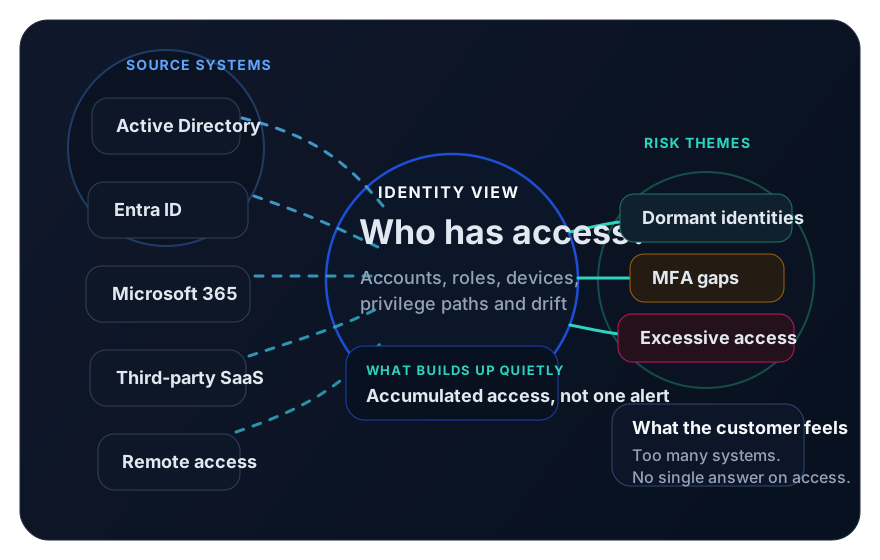
Ex-employees, dormant accounts, inherited group membership, and guest identities linger long after their business need has gone.
AD, Entra ID, M365, remote access, and line-of-business systems rarely move in lockstep. Risk hides in the gaps between them.
OAuth grants, service principals, shared mailboxes, and third-party SaaS create access paths that are hard to explain to a board and harder to govern at scale.
Security teams may suspect the issue. Boards, auditors, insurers, and managed service providers still need evidence, prioritisation, and a credible operating story.
Product progression
Most buyers should start with proof, then decide whether they need a controlled governance rollout. The product range follows that same path, with clear status on what is available now and what remains later-stage.
A read-only access review that gives you evidence-backed findings, a clear first action, and a report you can use internally.
Best for getting a clear first picture without making changes to the customer environment.
View MRIThe governed next step for organisations that want recurring review, reporting cadence, and tighter operating control after MRI.
Best for turning a one-off assessment into a repeatable operating rhythm.
View CoreLater-stage guided analysis and richer decision support for approved pilots, not broad public GA.
Best for more mature teams that need more than baseline monitoring.
View EnhancedThe most advanced layer for bounded, human-governed orchestration in approved private-beta programmes.
Best understood as an advanced future-facing layer, not the place most customers start.
View AISFGet Personalized Recommendation
Answer a few quick questions to get a tailored product recommendation based on your role and goals.
Shared substrate
The public website and demo layer explain the company, show representative workflows, and carry commercial and trust messaging.
The authenticated portal is the operator and customer experience for runs, reports, governance, posture, and presentation views.
The control plane handles runtime authority, licensing, orchestration, approvals, and connector execution boundaries.
Identity truth, graph, intelligence, evidence, and execution contracts. The reason the stack is more than disconnected dashboards.
Buyer fit
A clearer line from identity exposure to governance, resilience, audit evidence, and measurable improvement over time.
A credible MRI entry service first, then a path into recurring monitoring and governed expansion only where the client is ready for more.
Evidence-backed visibility, less guesswork, better prioritisation, and a more defensible operating model for hybrid identity estates.
Start where the evidence is strongest
IdentityFirst MRI is the public starting point because it is the clearest, safest first step: read-only evidence, explainable findings, and a clear next action. IdentityFirst Core follows as a controlled rollout, with IdentityFirst Enhanced and IdentityFirst AISF kept in private beta until they are ready for broader selling.
 HashiCorp Vault
 PostgreSQL

